
Slav Defense: Chebanenko Variation · D15
The Central Break That Won ItSamaganova vs Banini, 2026
Samaganova vs Banini turned on a forcing finish. When and why the centre is challenged with a pawn — the moment the structure changes, and the plans that change with it.
The game
- White
- Samaganova, Aleksandra (1943)
- Black
- Gertrude Banini (1667)
- Result
- 1-0
- Event
- Olymp 2026 Women
- Round
- 3.306
- Date
- 18 Sept 2026
- ECO
- D15
- Opening
- Slav Defense: Chebanenko Variation
- Length
- 22:08
- Level
- club
About this game
Samaganova vs Banini was decided by a forcing finish from the Slav Defense. The game ended here: 48. c6+ was the last move played, and Black resigned because the final position is decisively lost for Black — the engine rates it as winning for White. Any continuation is analysis, never something that happened. Played at Olymp 2026 Women, 2026.
Lessons
What you'll learn
Central pawn break
Timing pawn breaks like e4, b5 and c6 can completely change the structure and the plans.
Mating attack
Once lines open around an exposed king, forcing moves can turn positional pressure into a direct attack.
King in the centre
Black castled early, but after the king returned to the centre it became the main target.
Open-file control
The d-file gave Black activity, but file control alone was not enough once the king became exposed.
Chapters
How the video is organised
- 0:00Opening
- 3:03Middlegame
- 20:46Takeaways
Key positions
The moments that decided it
Queen Recaptures on d3
On d3, Black's bishop had just captured, and White's queen takes it straight back. It's a clean recapture, nothing more — material returns to level, and the structure stays simple, with both sides still shaping their development. The engine sees this as the natural reply, keeping a small, steady edge for White. For now it's just routine work: the real questions about the centre are still to come.
Rook Lifts to d3
White lifts the rook to d3, setting it up in front of its own pawns rather than pushing it straight down the file. From here it can swing along the third rank toward either wing once a target appears. The engine's slight preference was a knight hop to the same square, but the evaluation barely moves, from plus 0.38 to plus 0.30. Black, meanwhile, still wants to use the d-file pressure built up earlier to make this rook's life awkward. The real question is still open: which side gets the first central break to stick.
exd6: a passed pawn appears
Here the pawn on e5 has only one way forward, and it takes it, recapturing the rook on d6. The engine confirms it was the only move available, and material comes back level after the exchange. But the real story is the pawn left behind on d6. It's now passed, with no black pawn able to challenge it. White's task going forward is simple to state and hard to execute: keep pushing it, or use it to tie Black's pieces down.
b4 lets the edge slip
With a big edge already banked, the position asked White to keep breaking the centre open. Instead White pushed b4 on the queenside. It changes nothing material, but it lets Black off the hook: the evaluation drops from nearly four pawns to under one. White still stands better, just no longer close to winning outright. The task now is to find new ways back into the attack, since the cleanest route just slipped by.
Rook Swings to d3
White swings the rook back to d3, the second time this rook has shifted across the third rank. It is positioning rather than action, keeping the piece flexible with d6 still standing as a passed pawn in the centre. The engine actually preferred pushing the pawn to c5 here, which would have kept the initiative moving rather than pausing to reposition. The evaluation eases a little as a result, though White still holds a clear edge. For Black, the task is the same one it has been: find a piece to blockade before White's pawns and files start working together.
The Unrecovered Error
Black's queen pulls back to c8, and the backward pawn on b7 is left without extra support behind it. The engine's preference was quite different: pushing the h-pawn to h5, generating counterplay on the opposite wing while White is still tied to the queenside targets. Instead, the queen's retreat does nothing to address that weakness, and the evaluation leaps from a comfortable edge for White to something close to winning. This is the game's first unrecovered error. The advantage it hands White never slips away again. From here, every plan Black might have had to generate play elsewhere has to
Replay
Play through the game
Move 0 of 95. Positions are generated from the PGN by a deterministic chess library.
Keep learning
Related games
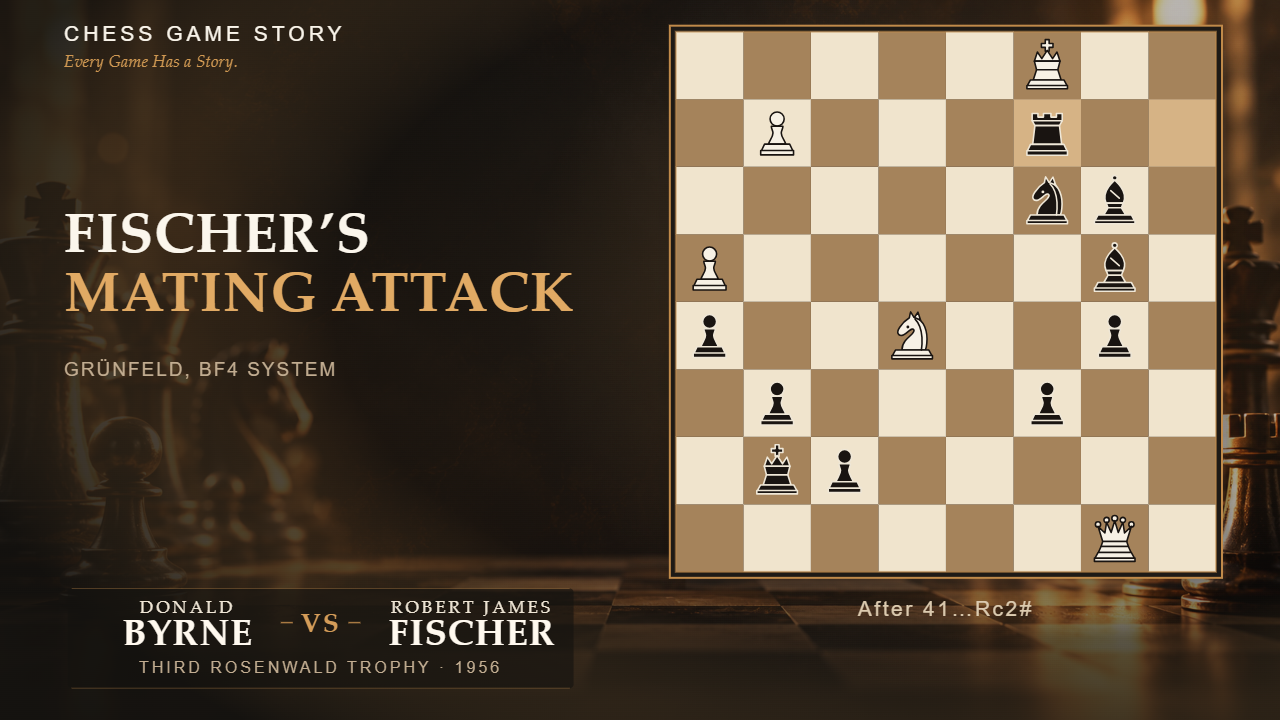 Grünfeld, Bf4 SystemD9217:52
Punishing 11.Bg5 | Byrne vs Fischer, 1956
Donald Byrne vs Robert James Fischer
Byrne vs Fischer turns into a mating attack after 11.Bg5. See how Fischer finds three forcing moves in a row, builds the initiative, and converts the attack into a win.
Also teaches Mating Attack
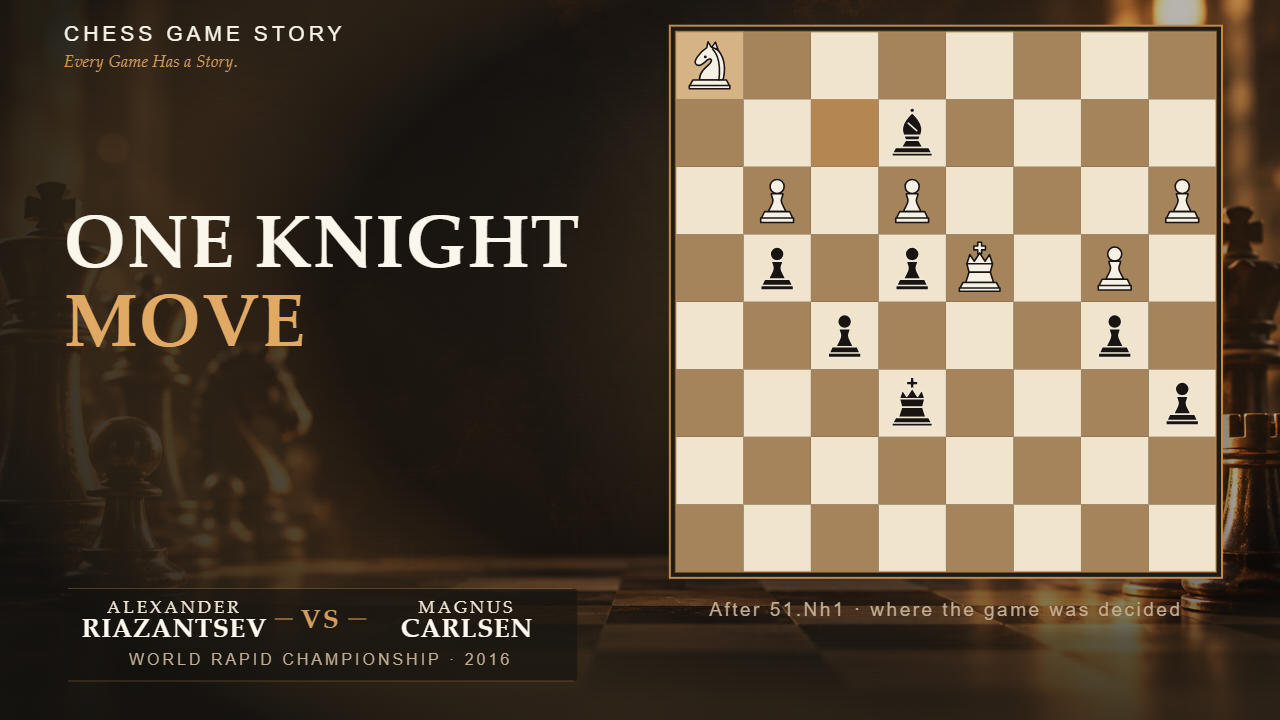 UnclassifiedD3723:24
The Knight That Went to the Corner | Riazantsev vs Carlsen, 2016
Alexander Riazantsev vs Magnus Carlsen
Riazantsev vs Carlsen turns on one decisive knight retreat. See how Carlsen converts the endgame through king activity, pawn creation, and precise piece coordination.
Also teaches Pawn Break
 Caro-Kann Defense: Advance Variation, Tal VariationB1214:48
One Queen Move Changed Everything | Panchol vs Jacob
Manyok Chaderek Panchol vs Jacob, Jallah
One queen move changed the course of Panchol vs Jacob. See how a central pawn break, open-file activity and a sequence of forcing moves turned a balanced Caro-Kann into a decisive attack.
Also teaches Pawn Break