
Grünfeld, Bf4 System · D92
Punishing 11.Bg5Byrne vs Fischer, 1956
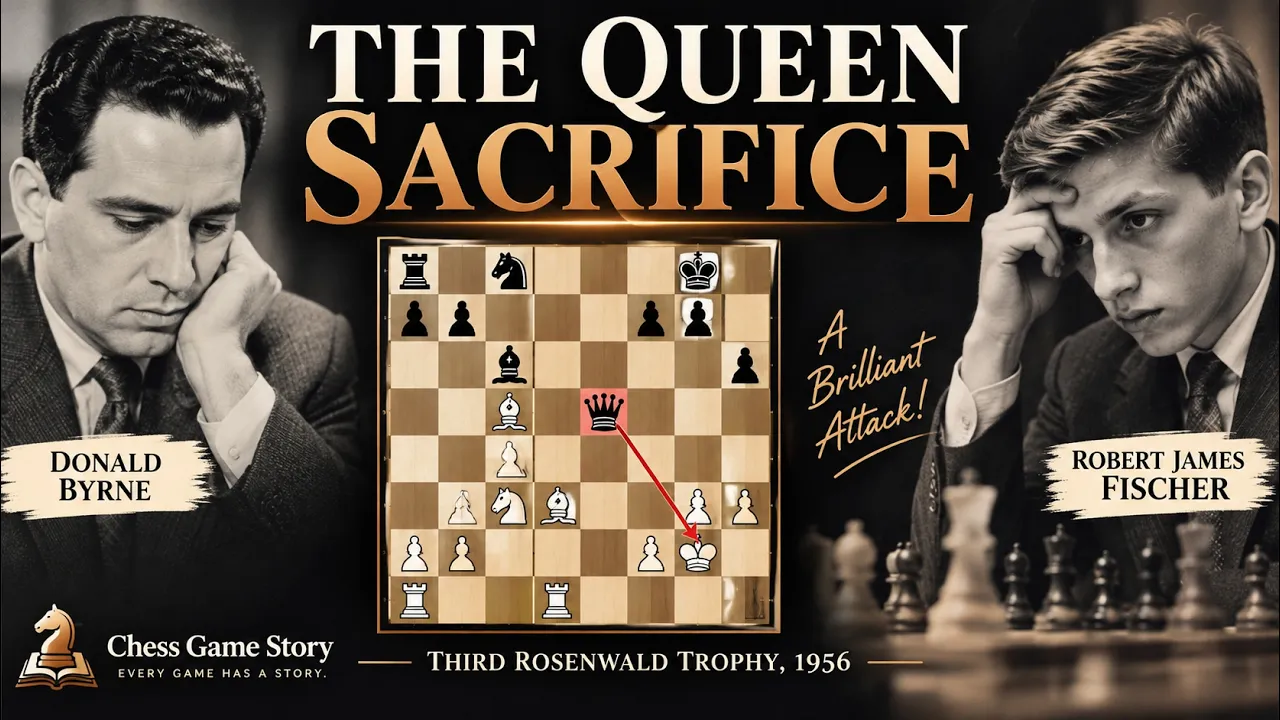
Byrne vs Fischer turns into a mating attack after 11.Bg5. See how Fischer finds three forcing moves in a row, builds the initiative, and converts the attack into a win.
The game
- White
- Donald Byrne
- Black
- Robert James Fischer
- Result
- 0-1
- Event
- Third Rosenwald Trophy
- Round
- —
- Date
- 17 Oct 1956
- ECO
- D92
- Opening
- Grünfeld, Bf4 System
- Length
- 17:52
- Level
- club
About this game
A Grünfeld middlegame turns on one move: 11.Bg5. Fischer finds every forcing reply, and the rest is a conversion from initiative to mating attack. Played at the Third Rosenwald Trophy in 1956.
Lessons
What you'll learn
Punishing the mistake
How Black turns White's 11.Bg5 into a lost position.
Forcing moves
How Black keeps the initiative with a sequence of checks the opponent must answer.
The queen sacrifice
Why Black gives up material worth 9 pawns and stays better.
Mating attack
How Black's attack is built and why the final sequence works.
Chapters
How the video is organised
- 0:00Opening
- 2:15Middlegame
- 16:38Takeaways
Key positions
The moments that decided it
11. Bg5 — the turning point
Here is the moment the game turns. White plays Bg5, rerouting the bishop but ignoring the king still stuck in the centre. The engine's preferred move was Be2, tucking the bishop in and getting ready to castle. Bg5 instead invites Black to start throwing pieces forward with tempo, and the evaluation swings by nearly three pawns in Black's favour. Nothing has been captured, no material has changed, but the position has changed character completely. White's king is going to pay for every delay now. Fischer is about to answer with a string of forcing moves, each one asking a question White must an
11...Na4: the only move
After Bg5, Fischer finds the only move that keeps Black's position together: the knight jumps from b6 to a4. It looks like it can simply be taken, but the engine's own choice is to leave it alone, because the knight is eyeing c3, and White's centre and king safety both depend on that square. One precise reply has already turned the position decisively in Black's favor, with the engine's evaluation holding steady at nearly three pawns in Black's favor.
Nxc3 wins a pawn
Fischer's knight grabs the pawn on c3. The point isn't just the extra pawn — it's what happens to White's structure. The d-pawn is now isolated, with no neighbor to lean on. That pawn becomes a long-term target, something Black can press against for the rest of the game while White has to keep defending it piece by piece. A small tactical gain just became a lasting structural one.
17. Kf1
Byrne tucks his king to f1, sidestepping the check he just faced. But the move leaves his rook on d1 sitting there, technically loose. The engine's own line doesn't bother grabbing it — Black has better business with Be6 and pressure on c3 — but it's a reminder of how little margin White has left. Every tempo now carries a cost, and the king on f1 is safer than e1 only in the narrowest sense: it still has no real shelter if the position opens further.
Bxb6: Material Over Safety
White now grabs the queen on b6, and it looks like the piece count settles the argument. But the engine disagrees sharply: taking the queen is the real mistake here, swinging the evaluation from a clear Black edge to something close to lost for White. The stronger try was the queen capturing on c3 instead, meeting the piece Black just offered rather than the one it seems to threaten. Taking on b6 leaves White up material on the scoreboard but badly behind on the board, because Black's remaining pieces are about to show exactly what that queen bought.
Bxc4+ — the only move
Now comes the only move that keeps Black's whole idea alive. Fischer plays Bxc4, check, picking up the bishop and dragging White's king further into the open. It's the engine's top choice here, and nothing else holds the position together. White still holds a material edge on the board, but that edge means little with the king stuck in the centre and the e-file wide open. Every check like this one makes that king's position sharper, and this advantage is one that holds for the rest of the game. The scoreboard still says White, but the real question now is how long that king survives out there.
Replay
Play through the game
Move 0 of 82. Positions are generated from the PGN by a deterministic chess library.
Keep learning
Related games
 Slav Defense: Chebanenko VariationD1522:08
The Central Break That Won It | Samaganova vs Banini, 2026
Samaganova, Aleksandra vs Gertrude Banini
Samaganova vs Banini turned on a forcing finish. When and why the centre is challenged with a pawn — the moment the structure changes, and the plans that change with it.
Also teaches Mating Attack
 Caro-Kann Defense: Advance Variation, Tal VariationB1214:48
One Queen Move Changed Everything | Panchol vs Jacob
Manyok Chaderek Panchol vs Jacob, Jallah
One queen move changed the course of Panchol vs Jacob. See how a central pawn break, open-file activity and a sequence of forcing moves turned a balanced Caro-Kann into a decisive attack.
Also teaches Forcing Sequence
 Grünfeld DefenceD9210:39
Donald Byrne vs Robert James Fischer — Third Rosenwald Trophy
Donald Byrne vs Robert James Fischer
One mistake hands over the initiative completely, and it never comes back. Donald Byrne against Robert James Fischer ends in checkmate, after bold play sets up a relentless king hunt.
Also teaches Punishing a Mistake